The Plymouth Brethren Christian Church has told two parliaments, fourteen years apart, that it is a loose fellowship of autonomous congregations with no hierarchy, no central records, no clergy and no businesses. This article does not argue with that. It simply sets out, from the church's own paperwork, the five things the church owns and operates — and lets the reader decide whether an organisation without a centre would build them.
What the church says it is
In Canberra on 21 August 2026, the church's spokesman Lloyd Grimshaw told the Joint Standing Committee on Electoral Matters:
“We have no constituent governing document other than the Holy Bible. These assemblies and congregations are unincorporated associations and autonomous in their functions, and there's no centralised recordkeeping.”
He added that there is “no clergy in the church or appointed ministers”, that “there are no employees in the church, there are no official positions or titles”, that “it's a Christian fellowship, so there is no hierarchical appointment to say these people are senior and these aren't”, and that “there is no such thing as a Brethren business because the church does not have any businesses, it doesn't have any vested interests.”
Six weeks later, in a written submission to the same committee, the church's worldwide leader Bruce Hales said he holds no office, that the church “has no hierarchical structure, no clergy and no appointed ministers”, that its congregations are autonomous, and that there is “no register of members' private activities, no command structure, and no officer who could truthfully answer for 16,000 private citizens.”
What follows is not a rebuttal. It is an inventory.
One — Connect
A verified register of every Brethren household in the world.
Connect is an application on the Google Play Store, published by UBT Global Software Development, a business of UBT Holdings Limited. It is described as a “Community Directory Application” and has been downloaded more than ten thousand times. Within the church it replaced a printed book that served the same purpose.
Its published privacy notice sets out what it holds about a member: photograph, name, email address, telephone number, home address, place of worship, location, links to other family members, and connections by marriage. That is a genealogical map of a worldwide religious community, maintained as software.
Two sentences in that notice matter more than the rest. The first is that information submitted to Connect is
“checked first by UBT staff… to ensure that personal information aligns with PBCC member records”.
A master set of PBCC member records therefore exists, somewhere, and is authoritative enough to validate what an individual says about themselves. The second is what happens when a member asks for their data to be removed:
“we will continue to hold it on our database… for the purposes of verification and ongoing recordkeeping for the PBCC”.
A company retains the record on the church's behalf after the member has asked for it to go. Whatever else that is, it is centralised recordkeeping.
The fuller picture is in the notice UBT published for Europe. Headed “Privacy Notice — GDPR compliant”, first issued on 6 July 2018 and amended on 15 June 2020, it covers the Connect App, the Connect Website, the Community Photobook and the Community Address Book, and it opens by saying exactly what the service is:
“The Connect Services provide information about individual members of the Plymouth Brethren Christian Church Community (“the Community”) and enable contact to be made between Community members worldwide… All Subscribers are verified as members of the Community before they are provided with log-in details. The App will only connect to Android phones with the UBT installed Streamline3 software.”
Verified membership is the condition of access, and the device must be running the church's own filtering software. The data listed includes an individual photograph, name, email address, telephone number, address, place of worship, links to other family members, and information as to employment. The Photobook adds family photographs, location and connections by marriage to other Community family groups — and the consent for publishing a household is given not by each individual but by “a Family Representative”.
The operator is named as UBT Marketing Pty Limited (ACN 162 091 796) as trustee for the UBT Marketing Trust, as licensee of the UBT Trust, at The Precinct, Sydney Olympic Park. Copyright in the Photobook and Address Book belongs to Universal Business Team Pty Limited. Information is transferred to UBT's “own centres of operation in Australia, Argentina, the Caribbean, New Zealand, Canada and USA”.
And the notice is explicit about who answers for it in Britain. It names a Data Manager at the UBT UK Regional Office, Exchange Place, Poseidon Way, Warwick CV34 6BY — the building pictured further down this page — and states that UBT is “responsible as ‘controller’” of this personal information under the General Data Protection Regulation “which applies across the European Union (including in the United Kingdom)”.
That matters, because of one sentence. Justifying its reliance on legitimate interests, the notice says the risk to privacy is minimal given, first, that “no sensitive data is processed”.
The entries record each person's place of worship, and the directory exists to list the members of one named religious community. Under UK data protection law, personal data revealing religious beliefs is special category data and needs a specific condition before it may be processed at all. There is such a condition for not-for-profit bodies with a religious aim handling their own members' data — but the operator named here is a commercial company, and the Photobook and Address Book are sold. We are not lawyers and make no finding; we note that the question of which condition applies is one the Information Commissioner's Office exists to answer, and that the notice itself names the ICO as the supervisory authority.
There is now a second app. ContactBase, on Apple's App Store, is described as “the essential mobile directory managed by UBT” offering members “global directory access” to “the entire UBT Global Network”. Its seller is UBT (EU) Ltd — the British company — and it carries the line “© UBT (EU) Ltd”. Its App Store privacy label declares “Data Not Collected”, a disclosure Apple states it has not verified. Its privacy page, at contactbase.ubtglobal.com, returns to the public only a footer: a copyright notice in the name of UBT Marketing Pty Ltd marking the contents “strictly confidential” and warning that UBT “will not hesitate to take appropriate legal action” if they are disclosed.
Two — the Global Media Stream
A private channel carrying one man's voice to every member.
The Global Media Stream is a members-only application. Recordings of meetings are placed on it and the membership listens in its own time. Both of the church's witnesses have now described it to the Australian parliament.
Mr Grimshaw told the committee that Bible readings “are recorded and then made available to members at a later date to listen to in their own time.” Mr Hales, answering the committee's tenth question in writing, confirmed that he leads a Bible reading every week and set out what he said in the one recorded on 20 April 2025.
So there is a broadcast network, owned by the church, closed to outsiders, running from the most senior elder to the entire worldwide membership. It carries content one way. There is no equivalent channel running back.
An organisation of genuinely independent congregations has no use for such a thing. You build a global distribution system for one person's words when one person's words are meant to reach everybody. The channel is the hierarchy, expressed as software.
Three — the Global Funding Team
A national fundraising command with targets, territories and monthly reporting.
The Global Funding Team has its own volunteer handbook, copyright The Grace Trust. It describes a process that would be recognisable in any sales organisation, and the handbook says so itself, calling the planning step “similar to Sales Planning”.
Charities within the network submit their requirements to the centre. The centre aggregates them into a National Target. That target is divided into area targets. Each delegate is allocated five to ten named donor households. Monthly reports track shortfalls against pledges. More than 550 people work on the United Kingdom team alone.
A meeting invitation circulated through the system reads:
“We ask that ALL Households join the Zoom meeting… It is expected that ALL households would attend.”
Set beside the claim that there is “no command structure”, this is a centre, a set of regions, named officers, assigned territories, individual targets and performance management. It is also the most complete available answer to a question the Australian committee has asked twice: how do thousands of members in different cities come to act in the same way at the same time? The church runs an operation on exactly that pattern every year.
Four — GAP and UBT
A central panel that directs the commercial side, and the company that serves it.
The church has an internal diagram of itself titled “The Community Ecosystem”. At the centre sits GAP — the Global Advisory Panel. Around it, the church's entities are grouped under five headings. The first heading is:
“Improve profits of Community businesses”
UBT sits under that heading. UBT (EU) Ltd sold £107.8 million of consultancy, accountancy, insurance, IT, telephony and vehicle services in 2024, gave away £22.2 million of profit, and recorded a corporation tax charge of £5,970. Its money flows through the network to the National Assistance Fund, whose filed accounts record only two sources of income — UBT and the Grace Trust — and from there to the schools.
A recording of a Global Funding Team meeting describes how the centre works in operational terms: GAP “has oversight and provides overall direction to the ecosystem”; entities are sorted into revenue raisers, consolidators and recipients; each prepares a five-year strategic plan and “they review that with GAP annually”. Businesses receive donation guidance expressed as a percentage of net profit, varying by region.
A church whose members happen to run businesses does not need a panel that reviews five-year plans and sets the giving percentage. A group does.
And this is not an outsider's reading of the diagram. At Strive 26 — the church's annual business event, recorded once and played to the membership in every time zone — the panel explained GAP to the community in its own words. Jeremy Joyce described its origins: GAP was set up “just over 10 years ago”, and “when questions came up through the ecosystem entities, they came to GAP for direction.” Logan Currie set out what it does with the money:
“We roll up each of the entity in the ecosystem. Each of the regional budgets get rolled up into a global budget. So that provides our total cost for operational expenses across the whole globe.”
And how the entities are held to it:
“Each month there is a meeting of each of these entities with a representation in each region, which GAP helps to facilitate. And at those meetings they discuss income versus budget, expenses versus budget and obviously any challenges there are any shortfalls over under budgets and how we're going to resolve it.”
Global budget consolidation and monthly performance review against it, by region. Caleb Hall, speaking for UBT at the same event, referred to the body above him as “the Global Board”, and gave its commercial objective: to “double total client net profit by 2030” and to see that “all of our 56,000 members prosper globally”.
There is no reading of those sentences in which the church has no centre, no hierarchy and no vested interest in its members' businesses.
Five — Vision
Members' savings, lent to members' businesses, with the margin going to the church's charity.
Vision Income Fund is a licensed New Zealand managed investment scheme. Brethren families can invest from $250. The fund lends the money to Brethren businesses, secured by personal guarantees and general security agreements.
Its Product Disclosure Statement says the fund is intended to provide “members of the Brethren community” with an investment product suited to the community's ethical requirements. Its statement of investment policy says it lends “predominantly to Brethren Community businesses”.
Investors receive a rate set each month by the investment manager, with a floor of the Official Cash Rate plus 0.45%. Everything the fund earns above that rate — the Residual, about 1.70% a year of a 2.50% total charge — is paid to Vision Invest Trust. The scheme's own documents state that Vision Invest “is ultimately owned by Vision Foundation Limited”, an Australian registered charity with net assets of A$262.3 million that made no grants to charities at all in its last financial year.
Until January 2023 the fund was called UBT Invest NZ Funds. Until March 2025 its investment manager and distributor was UBT Marketing Pty Limited — the company that owns Connect. One company held the register of who the members were and managed the fund their savings sat in.
We have examined this structure in detail separately: The Brethren's bank.
And one company the church simply owns
Everything above concerns bodies the church is connected to. There is one it owns outright, and it is on the Australian corporate register.
PBCC Services Pty Ltd, ACN 165 353 131, was registered in New South Wales on 16 August 2013 under the name Universal Support Team Pty Ltd. It was renamed PBCC Services on 6 July 2021. Its registered office and principal place of business is Level 6, 10 Herb Elliott Avenue, Sydney Olympic Park — The Precinct.
Its share register has one entry. All twelve ordinary shares, fully paid and beneficially held, are owned by:
PLYMOUTH BRETHREN CHRISTIAN CHURCH, ACN 158 542 075, 100 Wharf Road, Ermington NSW 2115
That is the company Lloyd Grimshaw appeared for on 21 August — the entity he described to the committee as “a secretariat entity that is the charity in Australia”, and the one Bruce Hales calls the Secretariat Entity in his submission. It is the sole shareholder of a proprietary company limited by shares.
Its board matters too. The directors appointed on 6 August 2021 are Lancelot Roy Nipper, Gregory Peter Slack and Merrick Lloyd Grimshaw — who is the Lloyd Grimshaw the church sent to the Joint Standing Committee on Electoral Matters on 21 August 2026. Kevin Noel Dunlop, a director since 2013, is also company secretary.
So the man who told an Australian parliament that the church “does not have any businesses” and “doesn't have any vested interests” sits on the board of a trading company wholly owned by the church entity he was appearing for.
To be fair to him: PBCC Services is itself registered as a charity with the Australian regulator, its constitution restricts its income to charitable objects and forbids distributions to its member, and being a director of it is in no way improper. That is precisely why the answer he gave is the problem. There was nothing to hide. There was simply a company, owned by the church, with him on the board, and a committee was told it did not exist.
What that company does is set out in its own constitution, adopted 1 July 2021. Its object is “providing administrative, financial and other support to a range of registered charitable entities and other charitable funds in Australia” and “acting as trustee and performing and discharging the duties and functions incidental thereto”.
And it trades. Its financial statements for the year to 30 June 2022 record revenue of $1,166,866, up from $565,530, across lines including Client Subscription Charges ($337,916), Consulting & Support Services ($133,769), Entity Management ($106,651), Accounting & Audit Services, Software Cost Recovery and Insurance Recovery. Expenditure of $1,386,891 includes Contract Labor of $706,669, Legal Costs of $137,525, Advertising, and a line for Public Relations. The balance sheet shows a $100,000 loan from the church itself and a deficiency in shareholders' funds of $234,069.
Set that against the line the church gave its own membership at Strive 26, two months after these accounts were signed:
“PBCC has no business interests and does not trade apart from minor administrative needs such as the PBCC website.”
And against what Lloyd Grimshaw told the Australian parliament: “there is no such thing as a Brethren business because the church does not have any businesses, it doesn't have any vested interests.”
There is a further point about those accounts. They were not audited or reviewed — the statements say so on their face — but compiled, and the compilation report names the firm as L. R. Nipper & Associates of PO Box 205, Ferntree Gully, Victoria. Lance Nipper is a director of PBCC Services Pty Ltd. The directors' declaration accompanying the accounts is signed by Lance Nipper, with the space for a second director left blank. The company's own former registered contact address at ASIC was PO Box 205, Ferntree Gully.
Readers of our charity work will recognise the pattern. In England and Wales we found trustees signing the independent examination of their own charity, examiners who are the treasurer's father, and charities registered care of the firm that prepares their accounts. This is the same arrangement, on the other side of the world, at the company the church owns.
Finally, the link to the money. The Vision Foundation is registered with the Australian charities regulator as “The Trustee for Vision Foundation”, ABN 42 450 621 746, established 14 March 2017. The contact email recorded against it on the regulator's own register is [email protected], and its address-for-service email is [email protected].
So the chain runs, on public registers, from end to end: the church company owns PBCC Services; PBCC Services exists to administer charitable entities and act as trustee; its directors and its domain are the registered contact for the Vision Foundation; the Vision Foundation owns Vision Invest; and Vision Invest manages the fund that takes Brethren families' savings and lends them to Brethren businesses.
And three more, for completeness
Five is where the argument is sharpest, but it is not the whole estate. Three further bodies operate across borders from a single centre, and each has a function the others do not.
The Rapid Relief Team is the only Brethren charity that provides a service to people outside the church. It was established in 2012 and 2013 with the help of a public relations firm, after the Charity Commission in Britain began questioning whether the church delivered any public benefit; its founding helped the church regain charitable status here. It now operates in multiple countries, and it was in the field at the Victorian bushfires and is currently catering the Pollie Pedal bike ride run by the Liberal Party's federal president. A recording of a Global Funding Team meeting describes it, in the church's own operational language, as “one of the key ways we protect and maintain the external reputation of our church”. Internal church documents instruct members to “engage with a person of influence or status at a local level”.
OneSchool Global is, as the name states, one school. It educates Brethren children on campuses across the world under a single identity and a single curriculum model. In the United Kingdom it spent £54.9 million in its last filed year educating 2,894 pupils — £18,974 per pupil, of which parents contributed £4,065, or 21%. The balance is met by the network and by the tax system; the charitable subsidy works out at £14,909 per pupil, and fees would have to be 4.7 times higher without it. In Australia the school network is substantially funded by government. An association of autonomous congregations does not run one school on four continents.
The Bible and Gospel Trust publishes the ministry. It is a registered charity in England and Wales, audited by Saffery, with £2.5 million of income across the five years to 2025. It is the body through which the writings of the church's leader are produced and circulated — the same writings Mr Grimshaw told the committee the secretariat exists in part to distribute, and the same corpus in which Mr Hales says a sentence put to the committee does not appear. A fellowship with no clergy and no hierarchy nonetheless maintains a charity whose purpose is publishing one man's teaching.
The Precinct
There is one more detail, and it is the kind that tends to settle an argument about whether an organisation has a centre.
The church's offices have a brand name. In London, the registered office of PBCC Properties UK — charity 1125717, company 06656919, known as the Central GH Trust until 9 January 2026, and the body that lends money to local gospel hall trusts across the country — is given in its own filed accounts as “The Precinct London, 1 Finsbury Square, London EC2A 1AE”.
In Sydney, UBT Marketing Pty Limited (ACN 162 091 796), the owner of the Connect membership directory and until last year the manager of the New Zealand fund, gives its address as The Precinct, Level 6, 10 Herb Elliott Avenue, Sydney Olympic Park. Vision Invest's own website gives its head office as the same Precinct at Sydney Olympic Park. GAP Global Pty Ltd is registered there too.
And in the English Midlands, UBT's United Kingdom headquarters at Warwick, CV34 6BY, carries the same name on a monolith at the entrance.
The Sydney Precinct is not simply an office. The Daily Telegraph reported in November 2025 that eight registered charities are stationed at that one address, each with current Brethren church members on their boards, holding combined net assets of $240 million at the end of the 2024 financial year. It also reported that the Australian Taxation Office raided The Precinct in March 2024, along with Brethren charities and the church's global school headquarters — and that UBT has since made a payment of several million dollars to the ATO under a voluntary disclosure covering fringe benefits and salary splitting, with two further matters still open.
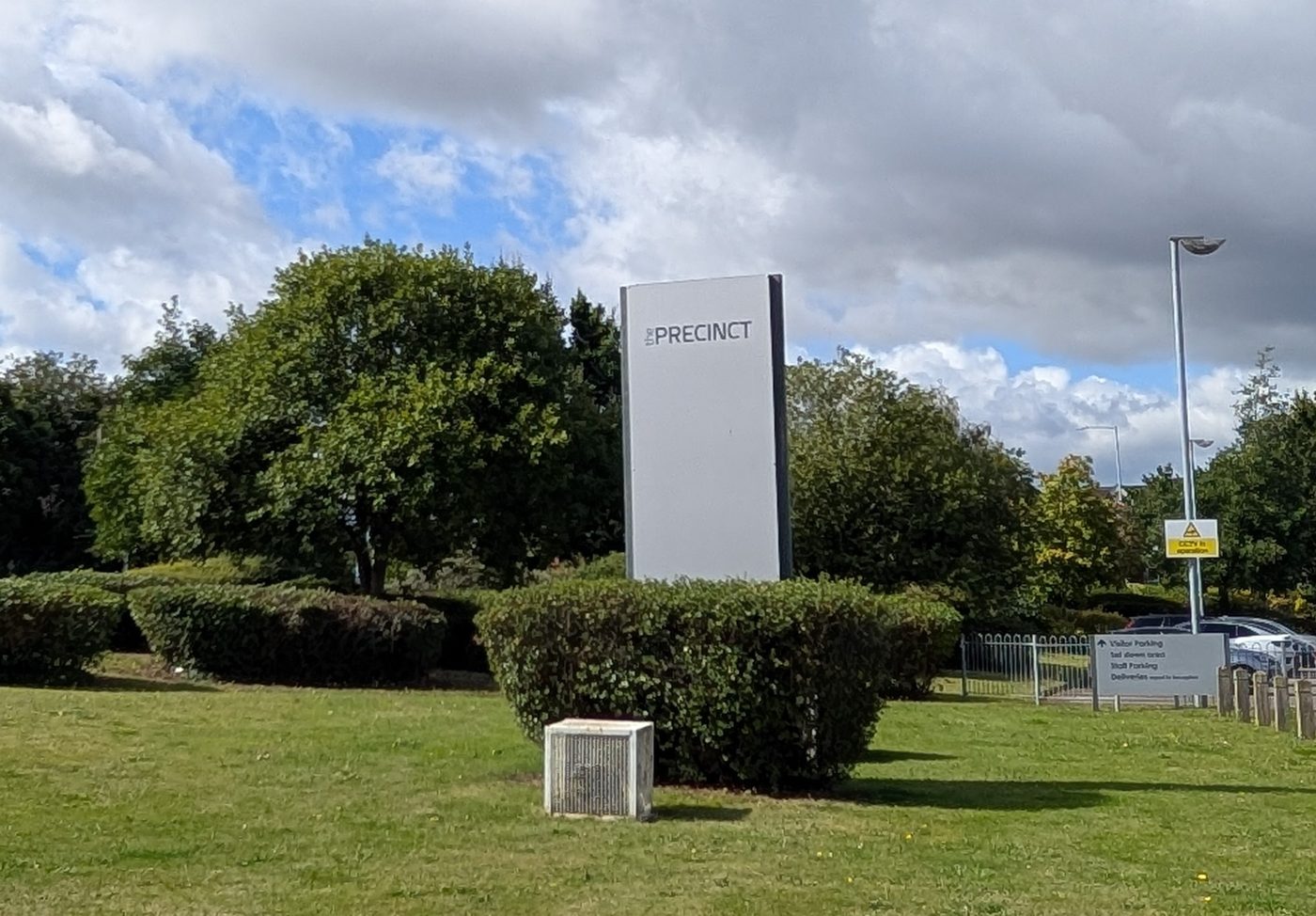
And it is not only the commercial side. The entities the church presents as separate and worldwide are not merely in the same building. They are on the same floor.
On the Australian charities register, the Rapid Relief Team (RRT) Ltd, ABN 61 166 059 392, gives its address as “L6, 10 Herb Elliott Ave, Sydney Olympic Park”. OneSchool Global Australia Ltd, ABN 88 613 500 182, gives “L 6 10 Herb Elliott Ave, Sydney Olympic Park”. On the companies register, PBCC Services Pty Ltd, ACN 165 353 131, gives Level 6, 10 Herb Elliott Avenue, and UBT Marketing Pty Limited, ACN 162 091 796, publishes the same: The Precinct, Level 6, 10 Herb Elliott Ave. Vision Invest's own website gives that Precinct as its head office. A second Rapid Relief Team company, ACN 164 674 195, and GAP Global Pty Ltd are registered at Sydney Olympic Park too.
The church's global humanitarian charity, its global school, its global business consultancy, its global investment manager and the company the church owns outright all operate from one floor of one office block in Sydney.
The Daily Telegraph's count of eight registered charities stationed at that address, each with current Brethren members on their boards and $240 million between them, is the same fact from the other direction.
So the global charity, the global school, the global business consultancy and the global investment manager share a street address and a brand. Each is presented as a distinct body with its own purpose and its own board. They are run from one commercial floor in Sydney Olympic Park, and from an office in Warwick and another in the City of London that carry the same name.
Three cities on three continents, one brand on the door. A loose fellowship of unincorporated associations does not have a corporate real-estate identity. “The Precinct London” is a name chosen by somebody with more than one precinct to name.
What this amounts to
Every item above is global. Every one is centrally administered. Every one is evidenced by the church's own material or by a company the church owns — a privacy notice on an app store, a volunteer handbook, an internal diagram, a product disclosure statement lodged with a financial regulator, a set of accounts filed with a charity commission. Not one of them originates with a critic, a former member or a newspaper.
And the convergence is tighter than the list suggests. UBT owns the directory that holds the membership. UBT sells the services the businesses buy. UBT's own entity managed the members' fund until March last year. The Global Funding Team handbook is copyright to the Grace Trust, which made £226.7 million of grants in England and Wales in five years. The addresses repeat.
In his submission, Mr Hales asked to be treated as the leader of any other faith would be. It is a fair test and it is worth applying. No other religious body in Australia or Britain maintains a verified worldwide register of its members' households, a private broadcast channel from its leader to all of them, a national fundraising organisation that assigns named families to named officers against monthly targets, a central panel that reviews members' business plans and sets the share of profits given away, and a licensed investment fund that takes its members' savings and lends them to its members' companies.
None of this is an allegation of wrongdoing, and none of these structures is unlawful. They are simply the opposite of what two parliaments have been told. A church may be organised however it wishes. What it cannot do is operate one of the most centrally coordinated international organisations of its size and tell a regulator, a committee and the public that it has no centre.
How this was put together
Lloyd Grimshaw's evidence is quoted from the official transcript of the Joint Standing Committee on Electoral Matters, 21 August 2026, with the qualification he gave: that when he said “the church” he was referring to the secretariat entity that is the charity in Australia, and that he was nonetheless “representing the Plymouth Brethren Christian Church and representing the fellowship”. Mr Hales's statements are from his written submission to the same inquiry, Submission 366, dated 5 October 2026 — which we have published in full, answer by answer, here.
PBCC Services Pty Ltd's registration, former name, address, officeholders and share register are from its current and historical company extract at the Australian Securities and Investments Commission; its object from its constitution as adopted 1 July 2021; and its revenue, expenditure, loan from the church, compilation report and directors' declaration from its financial statements for the year ended 30 June 2022, which state on their face that they have not been audited or reviewed. The Vision Foundation's ABN, establishment date and registered contact emails are as published on the Australian Charities and Not-for-profits Commission register. The March 2024 ATO raid, the eight charities at The Precinct and UBT's voluntary disclosure are reported by James Willis in the Daily Telegraph, 25 November 2025. The Connect listing is on the Google Play Store; the quotations are from the Global Privacy Notice for the Connect Services published by UBT, and from UBT's “Privacy Notice — GDPR compliant — Connect App and Community Photobook and Community Address Book”, version 2, 15 June 2020. The ContactBase listing, seller and privacy label are on Apple's App Store; the copyright and confidentiality wording is from the footer served publicly at contactbase.ubtglobal.com. Nothing in this article asserts that UBT has breached data protection law. “The Community Ecosystem” is the church's own internal diagram. The fundraising description is from the Global Funding Team volunteer handbook, copyright The Grace Trust, quoted briefly. The operating description of the ecosystem comes from a recording of a Global Funding Team meeting. The remarks of Jeremy Joyce, Logan Currie and Caleb Hall are from a transcript of Strive 26, the church's annual business event, held virtually and played to the membership in every time zone; they were speaking in their stated roles within the church's business ecosystem, and their words are quoted as given.
The Vision figures are from the scheme's Product Disclosure Statement, statement of investment policy and objectives, other material information document and audited financial statements to 31 March 2026, all on the New Zealand Disclose Register, together with Vision Foundation Limited's financial report for the year ended 30 June 2025 as filed with the Australian Charities and Not-for-profits Commission.
The charity and school figures are our own, built from Charity Commission register data for 205 Brethren charities in England and Wales for the years 2021 to 2025 with internal transfers netted, and from the filed accounts of OneSchool Global UK, UBT (EU) Ltd, the Grace Trust, the Bible and Gospel Trust and PBCC Properties UK. Addresses are as given in filed accounts, on the companies' own websites, on the register of the Australian Charities and Not-for-profits Commission — Rapid Relief Team (RRT) Ltd, ABN 61 166 059 392, and OneSchool Global Australia Ltd, ABN 88 613 500 182 — and on the register of the Australian Securities and Investments Commission — PBCC Services Pty Ltd ACN 165 353 131, UBT Marketing Pty Limited ACN 162 091 796, a second Rapid Relief Team company ACN 164 674 195 and GAP Global Pty Ltd.
Nothing here alleges that the church, any charity, any company or any individual named has acted unlawfully. The church denies that it was involved in the 2025 Australian federal election. Where this article states something, it rests on a document on a public register or a document we hold.
Brethren Intelligence has investigated the Plymouth Brethren Christian Church since 2020. The directory holds 8,409 companies and 9,000 individuals across 20 countries. The hundred largest companies by revenue are listed free here.
Full profiles, contracts, donations and filings — £14.99/year →